Luxium combines a ready-to-play polysynth with the freedom to reroute audio, drive controls at audio rate, and let every oscillator age and drift along its own path.
4simultaneous oscillators64modulation routes14filter models · two slots
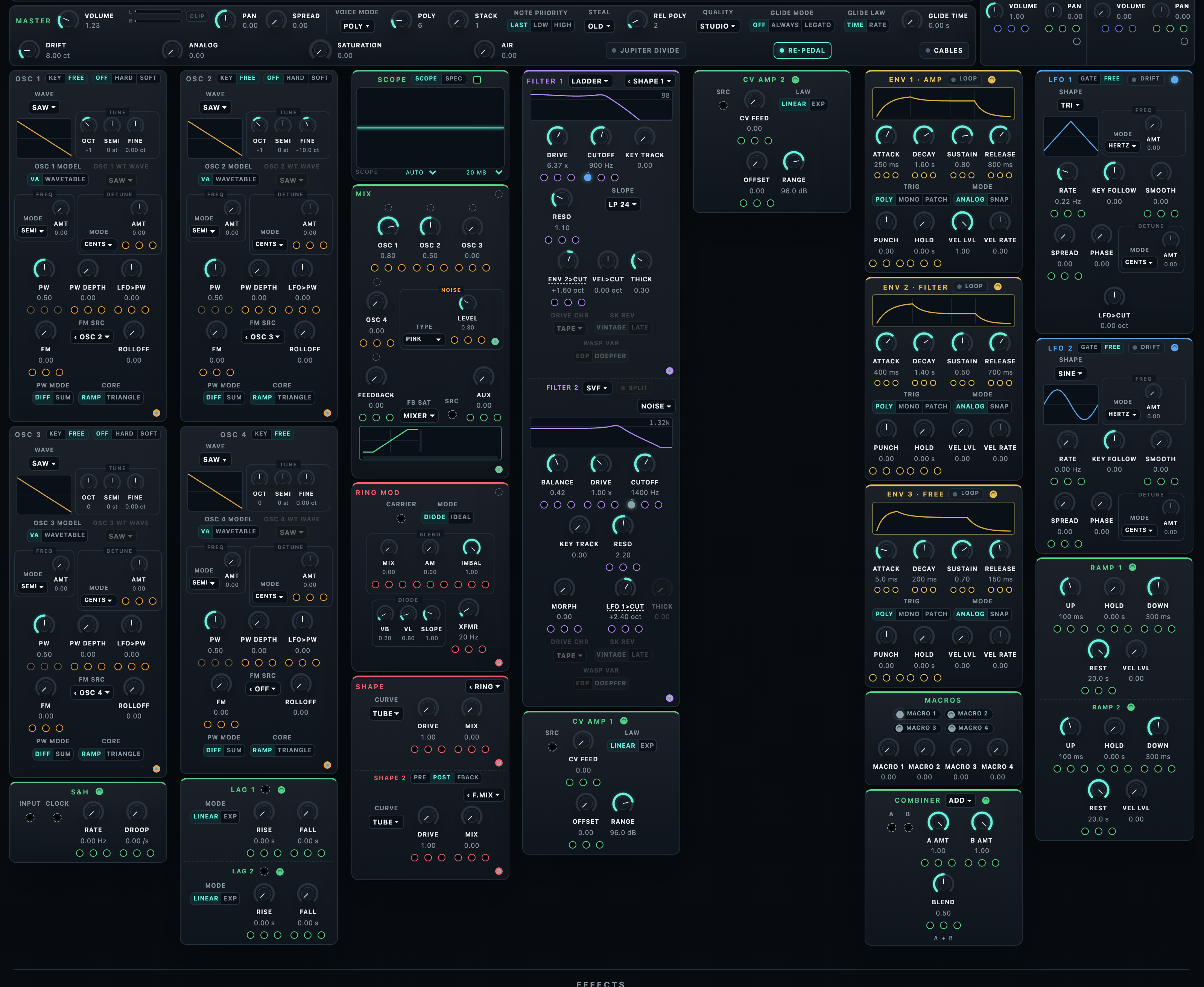
Voice page, cable view · four oscillators, mixer, ring mod, shapers, two filters, CV amps, envelopes, LFOs, ramps
Designed below the surface
Depth you can hear, route, and play.
The default path is immediate. The cable system opens it up: replace normalled connections, split oscillators into separate processors, create feedback paths, or use audio as modulation while notes are sounding.
4
independent oscillators
Layer, sync, cross-FM, detune, or route them separately. Four sources make combinations that two-oscillator voices cannot reach without stacking whole instruments.
6 / 14
audio inputs and tap points
Repatch filters, shapers, VCAs, noise, individual oscillators, external audio, and parallel paths. A cable cleanly replaces the normalled connection.
64
modulation routes
Patch envelopes, LFOs, performance controls, utilities, audio-rate oscillators, filters, and module outputs into the controls that matter.
14
filter models
Transistor and diode ladders, SEM, MS-20, Wasp, Prophet, Jupiter/Juno-style OTA, lowpass gate, formant, and comb structures fill two slots.
Why Luxium drift is different
Per oscillator. Per voice. Always moving.
Many virtual-analog designs apply variation at the voice level or add one global drift movement. Luxium models the smaller unit that actually wanders in hardware: every oscillator inside every voice. Four oscillators trace four independent tuning paths, with a shared environmental layer underneath. Turn Drift up and the voice blooms into a naturally changing, unison-like field without forcing every oscillator to follow the same curve.
Component-modeled character
A voice is more than a perfect waveform.
The Circuit controls reach into the behavior of the instrument instead of adding a character effect at the end. The Analog control gives each voice its own component tolerances. Drift moves every oscillator independently. Reset time, jitter, grit, sag, ramp curvature, filter drift, and saturation expose the imperfections that make physical circuits respond differently from one note to the next.
Luxium’s envelopes keep singing through voice changes: when polyphony is reallocated, the new voice inherits the current envelope level instead of dropping to zero. Jupiter Divide spreads the available voice pool across held notes and hands those envelopes across smoothly as the chord changes.
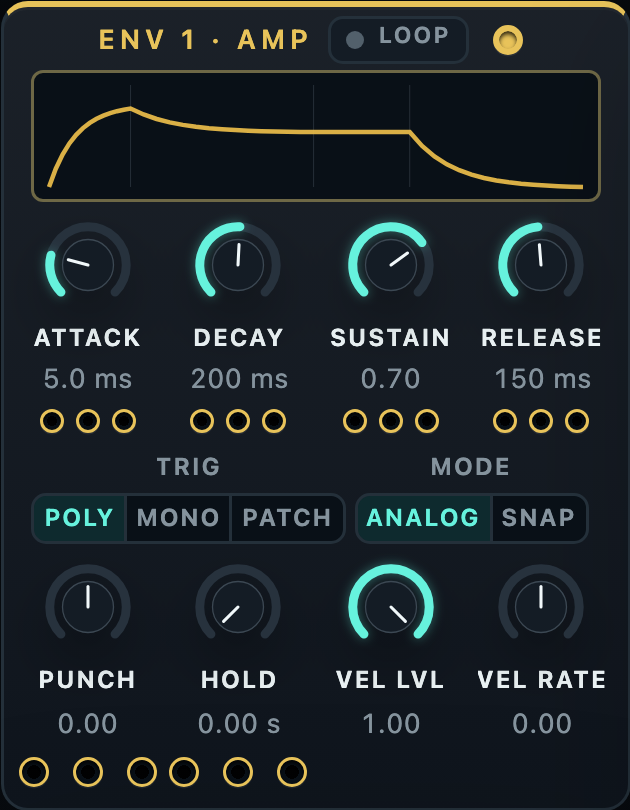
Env 1 · Amp
Analog and Snap envelopes
Choose asymptotic RC contours or sample-counted envelopes, then bend attack and decay with Punch, loop them, or route the free third envelope anywhere.
Jupiter Divide
One key can receive the entire voice pool; add notes and Luxium divides the pool evenly, preserving the musical handoff rather than restarting every contour.
Audio-rate modulation
An oscillator output can become filter FM, audio-rate pulse-width modulation, a sample-and-hold input, or the source for another path without a special mode.
Tuning
Tune in semitones, partials, hertz, beats, or a multiplier.
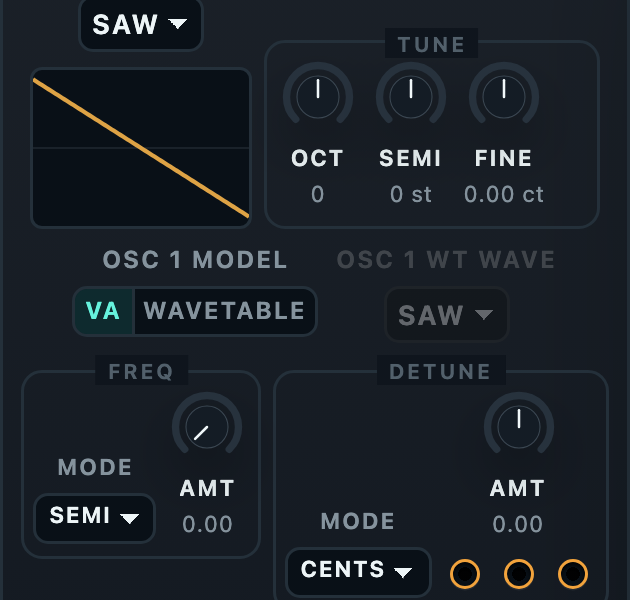
Each oscillator carries two tuning stages that stack. The first sets where the oscillator sits relative to the played note, or ignores the note entirely. The second adds an offset in one of four units. The LFOs carry the same pair, and the modifier amount is each oscillator’s pitch destination in the cable system, so a cable can move pitch in cents, hertz, beats, or as a multiplier.
Osc 1 · Tune, Freq, Detune
Frequency · 0 to 24
SEMI
Semitones above the played note. The ordinary case.
PARTIAL
An exact integer overtone of the note, first through 24th. Octaves land at 2, 4, 8, and 16 exactly, so a stack stays harmonic across the whole keyboard.
SUBHRM
An exact subharmonic, the note divided by 2 through 25. Trautonium-style undertone tuning.
HERTZ
An absolute frequency from 0 to 24 Hz that ignores the keyboard. The oscillator becomes a fixed formant or a second LFO, and at 0 Hz it holds a constant value.
SYNC
Locked to the host tempo as a note divider: 1 is a whole note, 4 is a quarter note.
Modifier · −50 to +50
CENTS
Up to ±100 cents, multiplicative. Detunes wider in hertz as you play higher, like every other synth.
HZ5
Up to ±5 Hz, additive. The beat rate against a second oscillator is the same on every key.
BEATS
A detune measured in extra cycles per whole note at the host tempo. +4 is one extra cycle per quarter note, so two oscillators beat in time with the song, at the same rate on every note.
MTPLY
Multiply the frequency by up to 50, or divide it by up to 50. At exactly 0 the oscillator freezes: its phase stops and it becomes a memoryless waveshaper of whatever is arriving at its FM input.
Beating that lands on the beat
Set two oscillators to BEATS and their phasing pulses in step with the transport. Chorus, unison shimmer, and slow filter-style swells from two detuned saws all become rhythmic, and the pulse stays even from the lowest key to the highest.
Detune that stays sweet up top
A cents detune that sounds lush in the bass turns sour two octaves up. HZ5 fixes the beat rate in hertz, so a pad or organ detune has the same slow drift on every note.
FM and ring modulation that stay in tune
PARTIAL and SUBHRM are exact ratios, so a modulator tuned to the third overtone stays the third overtone on every key. FM sidebands, ring-modulated stacks, and additive-style layers hold their harmonic structure as the melody moves.
An oscillator as a modulator or a voltage
In HERTZ or SYNC the oscillator ignores the keyboard and runs at a fixed or tempo-locked rate. Cable its output into any modulation destination and it is a tempo-synced LFO with the oscillator’s own waveforms and pulse shaping; at 0 Hz it becomes a fixed offset you can patch into a control.
Frozen oscillator, instant waveshaper
MTPLY at 0 stops the oscillator dead. Patch another oscillator into its FM input and the frozen waveform acts as a transfer curve: a sine becomes a smooth harmonic shaper, a saw folds and wraps, and the shaper's pulse-width and waveform controls become distortion controls.
Extreme ratios without a matrix
MTPLY at 50 puts an oscillator far into the harmonic series for bright FM carriers; divided by 50 it runs below the audible range for sub-bass or as a slow rhythmic source, all still tracking the key.
Patch the signal itself
Audio routing is part of the instrument.
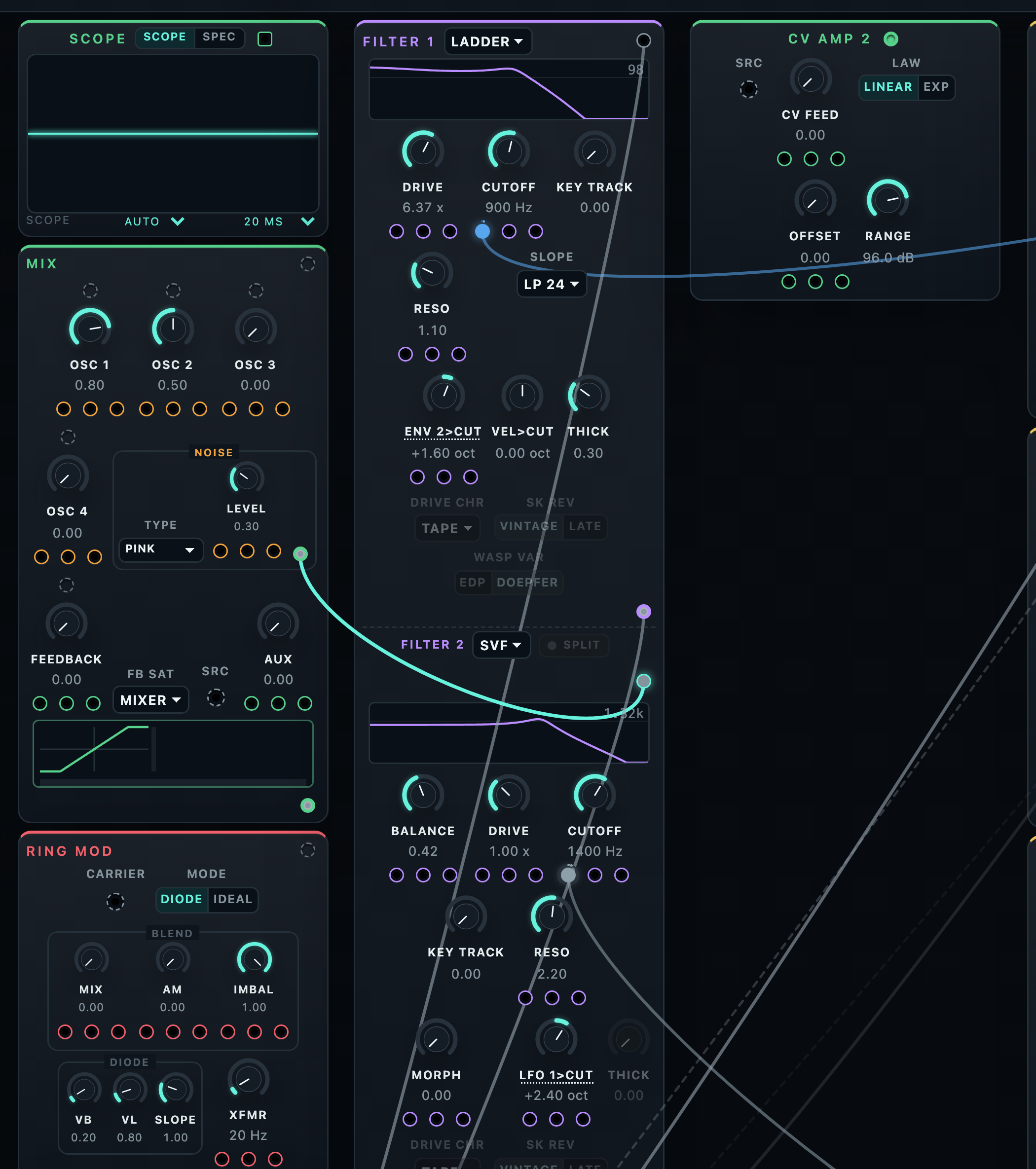
Cable view · noise into Filter 2, LFO 1 into Cutoff, Macro 1 into Cutoff 2
Break the normalled path
Send an oscillator around the filters, feed different sources into two filter slots, or put a shaper inside a feedback return.
Turn modules into sources
Oscillators, filters, envelopes, LFOs, utilities, and performance signals can drive the parameters around them.
Bring external audio inside
Route a guitar, drum loop, or another instrument through Luxium’s mixer, filters, modulation, amplifiers, cabinets, and reverb.
Public beta
75% off during the public beta
This early offer is for musicians who want to explore Luxium, report what they find, and help shape the workflow, sound, and capabilities of v1. The price will rise as Luxium matures, and we cannot guarantee how long the current promotion will remain available.